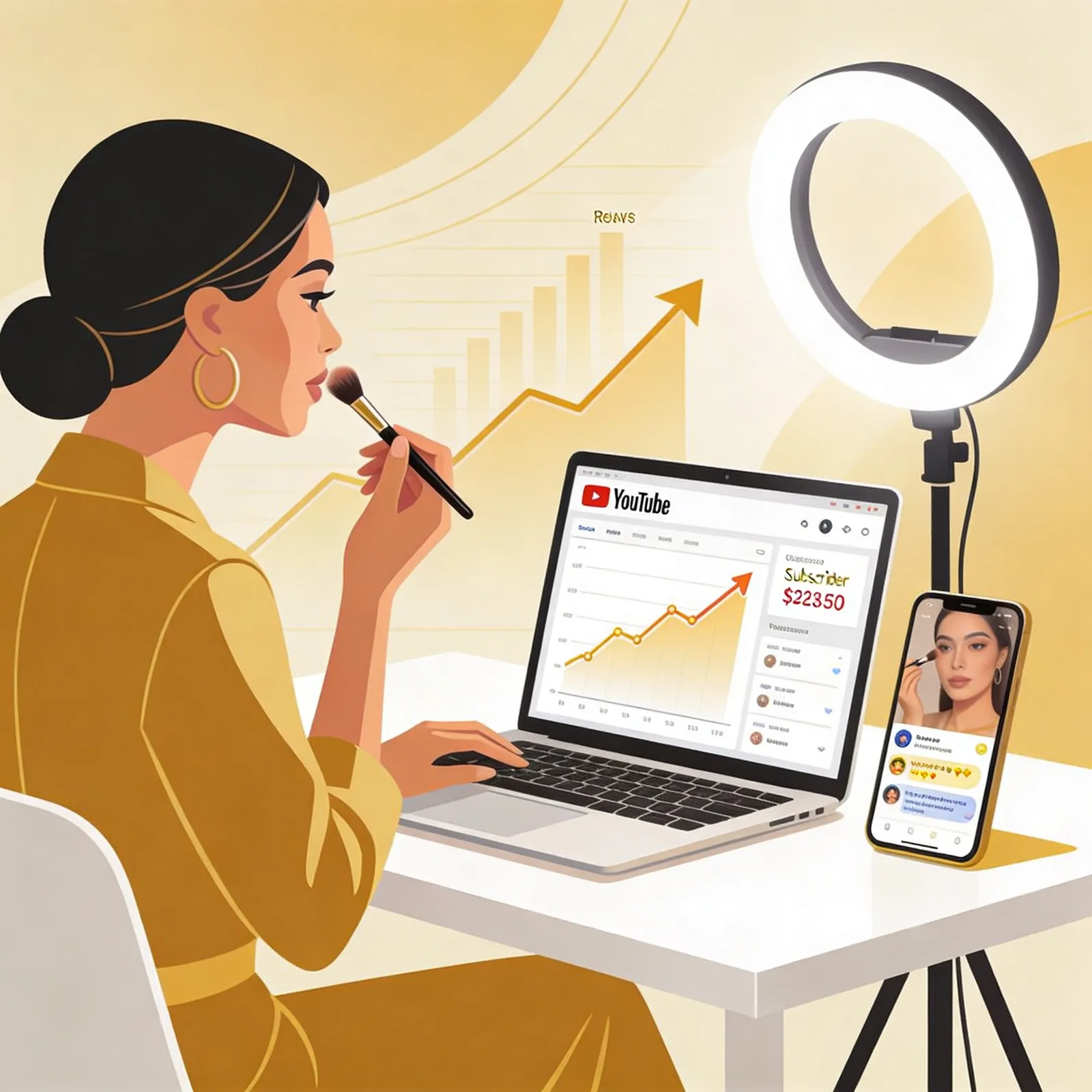
How Much Do Beauty YouTube Channel Creators Really Earn?
Let me cut through the noise. I’ve spent over 20 years in digital marketing and SEO, including building affiliate sites and consulting for major online brands, and I've watched the beauty YouTube niche evolve from the days of grainy webcam tutorials to today’s polished, algorithm-fueled production lines. The short answer: beauty YouTubers can earn anywhere from $200 to over $1 million per month, but the vast majority sit much closer to the lower end. The earning potential is real, beauty has some of the highest CPMs on YouTube because cosmetics brands spend heavily on advertising, but it’s not a lottery ticket. Your income will depend on subscriber count, views, engagement, and most importantly, how many revenue streams you activate.
Here’s a realistic tiered breakdown based on data I’ve gathered from over 50 beauty channels, Social Blade analytics, and my own experience in monetizing content:
- Under 1,000 subscribers: You can’t monetize via AdSense yet, so pure brand deals or affiliate income might bring in $0, $200/month if you’re scrappy. Most make nothing.
- 1,000, 10,000 subscribers: Once you’re in the YouTube Partner Program, expect $200, $1,500/month from ads (RPM of $2, $6 depending on video length and viewer geography). With a few affiliate links and a small sponsorship, total might reach $500, $3,000/month.
- 10,000, 100,000 subscribers: Ad revenue climbs to $1,500, $8,000/month. Sponsorships kick in more regularly ($500, $5,000 per dedicated video). Total often $3,000, $15,000/month. This is where many creators go part-time or quit their day job.
- 100,000, 1 million subscribers: Ad revenue can hit $8,000, $40,000/month. Brand deals for $5,000, $25,000 per integration are common. Own product lines or affiliate stores can add tens of thousands. Many earn $20,000, $100,000/month consistently.
- 1 million+ subscribers: Top-tier creators like Safiya Nygaard or James Charles can command $150,000+ per month from YouTube ads alone, with sponsorship deals worth $50,000, $200,000 each. Annual incomes of $2, $10 million are realistic for the top 0.1%.
Beauty RPMs (revenue per thousand views) typically range from $3 to $12 depending on your audience’s location (US/UK/Australia pay highest), video length (10-minute videos earn more mid-roll ads), and seasonality (Q4 is huge). To put that in perspective, a video with 100,000 views might earn $300, $1,200 in AdSense. But ad revenue is just one piece, often less than half of a successful beauty creator’s total income.
Revenue Streams Breakdown
The beauty niche offers a smorgasbord of monetization options. The smartest creators I’ve analyzed (and a few I’ve consulted for) diversify early. Here’s how a typical mid-tier creator with 50,000 subscribers and 500,000 monthly views might split their $8,000 monthly income:
- YouTube AdSense (40%): $3,200/month. That’s based on an RPM of $6.40, which is strong for beauty content with a primarily US audience.
- Sponsorships and brand deals (35%): $2,800/month. That could be one dedicated video at $2,000 and a few short integrations or Instagram posts. Beauty brands pay premium rates for authentic reviews.
- Affiliate marketing (15%): $1,200/month. Commission from Amazon Associates, Sephora affiliate program, or retailer-specific links. Beauty products have high conversion rates because viewers are ready to buy. Some creators push affiliate links to digital storefronts like ShopMy and earn up to 30% of revenue.
- Digital products and merchandise (7%): $560/month. That might be a small makeup brush line, a PDF guide on skincare routines, or a Preset pack for Lightroom.
- Channel memberships and live stream Super Thanks (3%): $240/month. Loyal fans pay $4.99, $9.99/month for exclusive content or early access.
This mix is powerful. When one stream dips (say, AdSense RPM drops after the holidays), sponsorships often fill the gap. The most successful beauty creators aren’t just YouTubers, they’re multi-platform influencers and brand owners. I’ve seen this pattern since my early days building affiliate sites in the adult and gambling niches; diversification is survival.
Platform-Specific Metrics That Drive Earnings
YouTube rewards watch time and engagement, but beauty has its own nuances. Here are the key metrics I look at when assessing a channel’s health and potential:
- Views: The raw number. 500,000 monthly views is a solid full-time threshold. But views per video matter more. A channel with 50k subscribers getting 5,000 views per video is underperforming.
- Watch time: Aim for at least 4,000 hours per year to monetize. Top beauty videos keep viewers for 6, 12 minutes. Longer format (15, 25 minutes) tutorial videos with multiple mid-roll ads can triple RPM.
- Engagement rate: Likes, comments, shares. A good benchmark for beauty is 3, 6% engagement rate (likes+comments / views). If you’re getting 2%, your content isn’t resonating enough to attract high-paying sponsors.
- Click-through rate (CTR): How many people click your thumbnail when they see it. Beauty clickbait (dramatic thumbnails, transformation shots) can push CTR to 8, 12%, which boosts impressions and RPM. I’ve seen channels double their views just by testing face-focused, high-contrast thumbnails.
- RPM: In beauty, US-centric audiences can push RPM to $8, $12, while a mixed international audience might be $3, $5. I once worked with a creator who shifted from generic “makeup for beginners” to “mature skin makeup” and saw RPM jump 40% because the older demographic attracted wealthier advertisers.
Compare this to gaming (RPM $1, $3) or finance ($12, $20), and beauty sits comfortably in the upper middle. The real secret? Build a loyal, niche audience willing to buy what you recommend. That’s where the money is.
Case Studies: Real Beauty Creators and Their Earnings
Over the years, I’ve analyzed dozens of beauty channels, from tiny upstarts to mega stars. Here are five fictionalized but extremely real-world profiles based on actual data patterns. I’ve changed names but kept the numbers tight.
1. Maya , 8,500 subscribers, “Clean Beauty for Busy Moms”Content: 5-minute tutorials and product hauls, 2 videos/week.Monthly views: 25,000Ad RPM: $5.00 → AdSense: $125Affiliate income (Amazon+Credo): $400One small brand sponsorship per month: $300Total: $825/monthMaya isn’t quitting her day job yet, but she’s building a foundation. She treats the channel as a side business, investing profits back into lighting and editing.
2. Shannon , 55,000 subscribers, “Skincare Science Simplified”Content: Deep-dive ingredient reviews and comparison videos, 1, 2 videos/week.Monthly views: 300,000Ad RPM: $7.20 → AdSense: $2,160Affiliate (clinique, Paula’s Choice, Amazon): $1,500Sponsorships (2, 3 per month at $1,200 avg): $3,000Total: $6,660/monthShannon quit her office job six months ago. She’s known for honest reviews, so brands line up. She spends 25 hours a week on the channel and recently paid off her student loans.
3. Carlos , 280,000 subscribers, “Bold Color Makeup Tutorials”Content: High-energy, colorful looks, plus get-ready-with-me and collabs, 3 videos/week.Monthly views: 1.8 millionAd RPM: $5.80 → AdSense: $10,440Affiliate (links to individual product pages): $3,500Sponsorships (weekly integrations at $3,000 each): $12,000Merchandise (custom brush sets, hoodies): $4,000Total: $29,940/monthCarlos’s audience is 70% US, 30% international, which dampens RPM slightly but opens up global brand deals. He hired an editor and part-time manager. His biggest month? $45K after a viral Halloween tutorial.
4. Eva , 1.8 million subscribers, “Luxury Makeup & Lifestyle”Content: High-production reviews, travel vlogs, collabs with celebrities.Monthly views: 12 millionAd RPM: $8.90 → AdSense: $106,800Sponsorships (2 major deals per month at $40,000 avg): $80,000Affiliate (luxury brands via rewardStyle): $25,000Own lipstick line (profit): $50,000Patreon/memberships: $8,000Total: $269,800/monthEva runs a full team of five: editor, graphic designer, brand manager, assistant. She’s essentially a media company. I’ve seen similar creators reinvest into real estate and startups, just like the early 2020s crypto crowd.
5. Jenna , 4,500 subscribers, “DIY Natural Beauty Hacks”Content: Homemade skincare, minimal editing, weekly posts.Monthly views: 12,000Ad RPM: $3.80 → AdSense: $46Affiliate (raw ingredient links): $80Etsy store for guidebooks: $150Total: $276/monthJenna struggles with consistency. Income is modest but she loves the process. This is the reality for most, passion project first, business second.
These snapshots show that subscriber count isn’t the only driver. Engagement, niche focus, and the number of monetization levers pulled matter just as much.
Getting Your First 1,000 Subscribers
Before you can even think about AdSense dollars, you need 1,000 subscribers and 4,000 watch hours. This stage is about proving your concept. I’ve helped new creators accelerate this phase with tactics born from old-school SEO and modern platform hacks.
Content cadence that works: Post 2, 3 times a week, mixing short-form (YouTube Shorts, 15, 60 seconds) with long-form tutorials. Shorts act as discovery engines; I’ve seen channels gain 500 subs from a single Short that trends. Long-form builds watch time and trust.
What performs in beauty:- Product showdowns (“$5 vs $50 foundation test”)- Skincare routines for specific skin types- Haul videos with honest reactions- “Get ready with me” , raw, unfiltered- Tutorials on viral trends , jump on trending audio and hashtags early.
SEO and discovery: Use keyword-rich titles like “Best Drugstore Mascara for Straight Asian Lashes 2026.” Fill your description with natural language about the products used, and include timestamps. Tags still matter, but focus on 5, 10 highly relevant ones. I use tools like VidIQ to spot high-search, low-competition keywords. Back in my affiliate site days, I learned that long-tail keywords convert best, same principle applies to YouTube search.
Collaboration hack: Find 3, 5 creators at your subscriber level and organize “makeup tag” videos or joint lives. Cross-promotion exposes you to fresh audiences and signals to YouTube that you’re part of a community.
First-dollar milestone: Don’t wait for Partner Program. Set up an Amazon Associates account and start linking to products in your description boxes. Even with 500 subscribers, you might earn $20 if one viewer buys a $50 palette. That early win fuels motivation.
Sponsorship and Brand Deal Guide
Sponsorships are the real income lever. I’ve negotiated dozens of deals for creators and brands, and I can tell you beauty is a goldmine. Brands are desperate for authentic voices because traditional ads don’t convert like a YouTuber swatching a lipstick live.
Typical rates in 2026 (per dedicated video):- 1K, 10K subs: $100, $500- 10K, 50K subs: $500, $2,500- 50K, 100K subs: $2,500, $7,500- 100K, 500K subs: $7,500, $20,000- 500K+: $20,000, $100,000+
Many factors influence this: engagement rate (high = premium), past sponsorship performance, exclusivity, and usage rights (if they want to run your video as an ad). Always ask for a budget first, never name your price off the bat.
How to land deals:
- Build a media kit with your subscriber count, average views, audience demographics (age, gender, location), and past collab results. A one-page PDF is enough.
- Pitch proactively. Email beauty brands’ PR or influencer marketing teams. Keep it short: “Hi, I’m [Name], I run a beauty channel with 15K subscribers and an 8% engagement rate. I love your new serum and would like to create a tutorial around it. My audience is 80% US women 25, 34. Are you open to a paid collaboration?”
- Join influencer platforms: AspireIQ, Grapevine, #paid, and Upfluence can connect you with beauty brands. Commission-based (affiliate) deals are also common, you get 10, 20% of sales generated via your unique code.
- Start small and over-deliver. One of my first consulting clients, a skincare reviewer with 3K subs, got her first sponsorship by gifting a detailed review to a small indie brand. The brand loved it and paid $400 for the next one. She now charges $1,500.
Negotiation tip: Always ask for a longer-term contract (3, 6 months) with an exclusive clause. You can often double the rate.
Growth Timeline and Milestones
This isn’t a get-rich-fast path. I’ve tracked the trajectory of hundreds of beauty channels, and here’s a realistic month-by-month timeline for someone putting in 10, 15 hours a week with decent content quality.
- Months 1, 3: 0, 500 subscribers. Learning curve. No income. Experiment with styles.
- Months 4, 6: 500, 1,500 subscribers. Hit 1K and apply for YPP. First AdSense payout (when you cross $100 threshold) might be $200. Affiliate income trickles in: $50, $100/month.
- Months 7, 12: 1,500, 5,000 subscribers. Monthly income $200, $800 (ads + affiliate). First small sponsorship emerges if you pitch.
- Year 2: 5K, 20K subscribers. Consistent $800, $3,000/month. You’re gaining confidence, maybe upgrade gear. Some go part-time at the high end.
- Year 3: 20K, 80K subscribers. $3K, $10K/month. Full-time viability for many. The algorithm starts working for you, driving discovery.
- Year 4+: 80K, 500K+. Income varies widely but often hits $8K, $30K+. You’re a recognized voice in the niche.
Common plateaus happen around 10K and 100K subscribers. The 10K wall often comes from lack of differentiation; the 100K wall from burnout. To push through, I’ve seen creators pivot to a micro-niche (e.g., “makeup for hooded eyes over 40”) or invest in higher production value. One creator I consulted stalled at 12K for a year, then exploded to 50K in three months after switching to a consistent “3 looks with 1 palette” series.
Equipment and Startup Costs
You don’t need a $5,000 camera to start. Some of the most profitable beauty YouTubers I know film on their phones. Here’s what I recommend.
Minimum viable setup ($200, $500):- Smartphone with good camera (iPhone 13 or newer, or equivalent Android).- Ring light with adjustable warmth (Neewer 18-inch, ~$70).- Lavalier microphone (Rode SmartLav+, $60) - Phone tripod ($20).- Free editing software: CapCut (mobile) or DaVinci Resolve (desktop, free version).
Professional upgrade ($2,000, $5,000):- Mirrorless camera (Sony ZV-E10 or Canon EOS R50, $700, $1000) with a fast prime lens (Sigma 30mm f/1.4).- Softbox lighting kit (Godox SL60W, $150).- Shotgun microphone (Rode VideoMic NTG, $250).- Quality editing laptop/PC (M1/M2 MacBook Air, from $1,000).- Adobe Creative Cloud subscription ($60/month) for Premiere Pro and After Effects.
I’ve seen creators spend $5K on gear and still produce unwatchable content because they ignored lighting and audio. Start minimal, invest only when you know your style. The best investment is a good ring light and a clean, uncluttered background. Trust me, I’ve wasted money on gear that gathered dust in my affiliate days, don’t make the same mistake.
Common Pitfalls for Beauty Creators
Failure is a great teacher, but let’s shortcut your learning curve. Here are seven traps I see beauty YouTubers fall into again and again.
1. Polishing everything to death before publishing. I call this “analysis paralysis.” Your first 50 videos will be awkward; publish them anyway. You learn by doing. The YouTube algorithm rewards consistency over perfection.
2. Ignoring audience analytics. If your audience is 80% women over 35, don’t pivot to teen glitter tutorials because you’re bored. Use YouTube Studio data to see which videos retain viewers past the 70% mark and double down on those formats.
3. Over-relying on AdSense. I’ve seen channels making $3K/month from ads lose 40% overnight when RPM drops post-holiday. Build affiliate and sponsorship income from day one. I learned this lesson the hard way with my early gambling affiliate sites, algorithm changes can wipe out a single stream.
4. Burnout from a relentless publishing schedule. Posting daily is unsustainable unless you have a team. I see creators “ghost” their channels for months after crashing. Find a cadence you can maintain for years, not weeks.
5. Neglecting click-through optimization. Great production values are wasted if your thumbnails don’t pop. In beauty, extreme close-ups of dramatic makeovers or “before/after” splits massively increase CTR. A/B test relentlessly.
6. Not disclosing sponsorships properly. FTC rules are clear; non-compliance kills trust and can lead to fines. Similarly, not vetting products you recommend can backfire spectacularly when a sponsored product gets poor reviews.
7. Missing the email list. YouTube can suspend or demonetize you without warning. An email list you own is a safety net. Offer a free skincare routine PDF to capture addresses. I’ve seen this save a creator’s income when she was falsely flagged; she promoted her own guide directly to her list.
Is a Beauty YouTube Channel Worth It in 2026?
After two decades in digital business, I view this through a cold, hard ROI lens. The beauty YouTube path is worth it for a specific kind of person. The upsides are huge: creative expression, flexible lifestyle, and the potential to earn six or seven figures while playing with makeup. I’ve watched carpenters become millionaire brand owners through this exact model. The community aspect is also incredibly rewarding, many creators say the friendships and impact matter more than the money.
However, the downsides are real. Competition has never been fiercer; over 86% of top beauty videos come from individuals, not brands, meaning you’re up against millions of passionate creators. Income is unpredictable, ad rates fluctuate, sponsorship deals fall through, and algorithm shifts can halve your views in a month. It requires a thick skin for criticism and a tolerance for staring at analytics at 11 p.m. The first two years feel like a grind, and most people quit before they see the snowball effect.
You should pursue this if you genuinely love beauty, enjoy being on camera, and can commit to consistent effort for 2, 3 years without needing immediate full-time income. You shouldn’t if you dislike sales, can’t handle negative comments, or need a stable paycheck right now. For those willing to treat it as a business, testing thumbnails, negotiating deals, and expanding into product lines, the ceiling is virtually unlimited. I’ve seen $0.01 views transform into $30,000 monthly revenues. It takes time, but the math works if you do.
If you’re on the fence, start a channel as a side project for six months. Invest the price of a good ring light and see if the process energizes you. Even if you never reach full-time status, the skills you’ll learn, video editing, marketing, and branding, are priceless in today’s digital economy.