How to Make Money with a SaaS
SaaS (software as a service) is cloud software sold on subscription. Revenue is predictable, and one codebase serves any number of users.
Common pricing models:
- Freemium: Free basic tier, paid upgrades (Dropbox grew to 700M+ users this way).
- Tiered subscriptions: Starter ($9/mo), Pro ($29/mo), Enterprise ($99+/mo). OpenView Partners puts 80% of SaaS companies on this model.
- Usage-based: Per API call or per user (Twilio bills $0.0075 per SMS).
- White-label: Agencies resell your tool for a cut.
Beyond subscriptions: upsells, add-ons, affiliates, and marketplace deals like AppSumo. Baremetrics data puts bootstrapped SaaS margins at 70-90% once scaled.
Solve one painful problem for one niche, say a $19/mo invoicing tool for solopreneurs.
How Much Can You Earn?
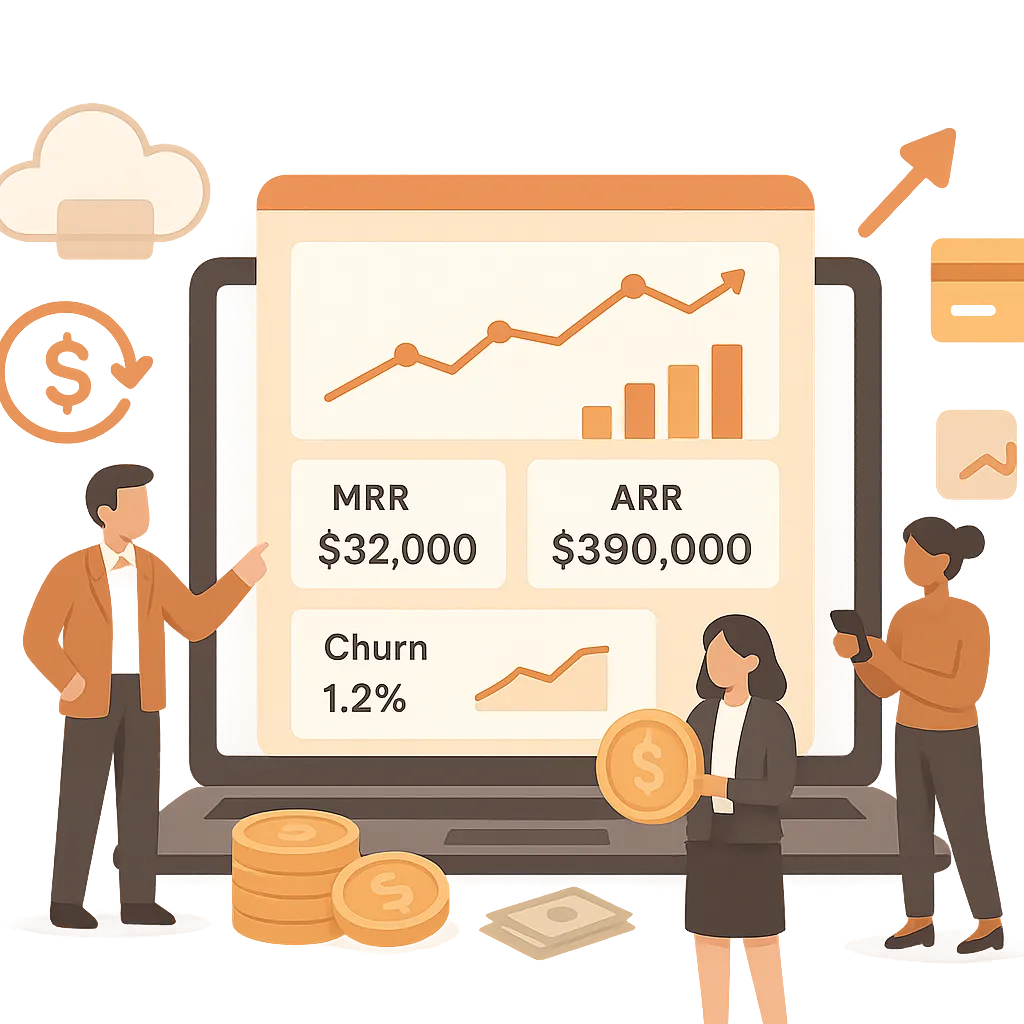
CB Insights puts SaaS startup failure at 90% within 2 years. IndieHackers' analysis of 1,000+ products puts the bootstrapped average at 12-24 months to reach $10k MRR (monthly recurring revenue).
Typical ranges from IndieHackers, Baremetrics, and SaaS surveys:
- Beginner (0-12 months, solo): $0-$5k MRR. Most stall at $0 for lack of validation; the top 10% reach $1k with a no-code MVP. Median after launch: $129 MRR.
- Intermediate (1-3 years, small team): $5k-$50k MRR. About 25% of IndieHackers products pass $10k, usually on SEO and content. $20k MRR is $240k ARR.
- Advanced (3+ years): $50k-$1M+ MRR. ConvertKit bootstrapped to $30M ARR; VC-backed Calendly sits at $200M ARR.
Keep monthly churn under 5%. At 20% month-over-month growth, $1k MRR becomes $10k in 12 months.
Getting Started
You no longer have to code from scratch. The usual sequence:
- Validate (1-4 weeks, $0-500): Survey 100 potential users on Reddit, Product Hunt, or LinkedIn. Pre-sell from a Carrd ($19/yr) or Gumroad landing page; 10 sales at $49/year is a reasonable bar.
- Build an MVP (4-12 weeks, $0-5k): No-code first with Bubble ($25/mo) or Airtable plus Zapier. If you code, Next.js plus Supabase (free tier). One to three core features, tested with 50 beta users.
- Billing and legal (1 week, $100-500): Stripe (2.9% + 30¢ per transaction), Paddle for global tax, an LLC via Stripe Atlas ($500), a privacy policy via Termly (free).
- Launch (day 1, $0-2k): Product Hunt (a top 5 spot brings around 10k visitors), Hacker News, Twitter, 50% off the first year.
- Acquire and retain (ongoing): SEO for the bulk of traffic, two blog posts a week, Facebook or LinkedIn ads at a $5-10 CAC target, ConvertKit for email. Aim for LTV:CAC above 3:1.
- Scale (6+ months): Freelancers on Upwork, Intercom for support, more tiers and integrations (Zapier marketplace).
$1k MRR in 3-6 months is possible. Budget $1k-10k to bootstrap.
Pros and Cons
Pros:
- Recurring revenue: 5-10x the lifetime value of an ecommerce customer.
- Scalable: One user or a million on the same code, with 80%+ margins at scale.
- Global: No inventory, and Stripe reaches 190 countries.
- Exit potential: $3-10M acquisitions are common (SavvyCal sold for $5M).
- Flexible: Remote and side-hustle friendly; half of IndieHackers founders are solo.
Cons:
- Competition: 30k+ new SaaS products a year (BuiltWith).
- Churn: 5-7% monthly is average, which halves your user base in a year.
- Upfront cost: 500+ hours for an MVP, and $50k+ in marketing to reach $10k MRR.
- Tech debt: Scaling means developers at $100k+/yr.
- Dependency: AWS or Stripe outages hurt; downturns spike churn.
Suited to technical founders or no-coders with grit. Not passive income at the start.
Tools You Need
Under $200/mo to start:
- Building: Bubble ($25/mo), Webflow ($12/mo sites), Supabase (free backend).
- Payments: Stripe (2.9%), Lemon Squeezy (global, 5% fee).
- Analytics and marketing: Google Analytics (free), PostHog ($0-450/mo), ConvertKit ($29/mo emails).
- Support and SEO: Intercom ($39/mo), Ahrefs ($99/mo), Notion (free).
- Deployment: Vercel (free), Render ($7/mo).
Start no-code and migrate to code around $5k MRR.
Real Examples
Bootstrapped examples from IndieHackers and Product Hunt:
- Carrd (AJ): One-page sites. $1.4M ARR ($108k MRR) at $9-49/yr per user. Launched 2016, solo-built, no VC.
- ConvertKit (Nathan Barry): Email for creators. $30M ARR in 2024, bootstrapped through blogging and SEO. Churn under 1%.
- Pieter Levels (NomadList): $500k+ ARR across his suite, built in public on Twitter.
- SavvyCal (Dharma): Scheduling. Peaked at $1M ARR, sold in 2020, no-code MVP built in weeks.
- Failure: 80% never reach $1k MRR. Generic CRMs without product-market fit are the classic case.
HubSpot did $2.17B ARR in 2023, but $10k-100k MRR solo is the more useful benchmark. The launch write-ups are on IndieHackers.com.