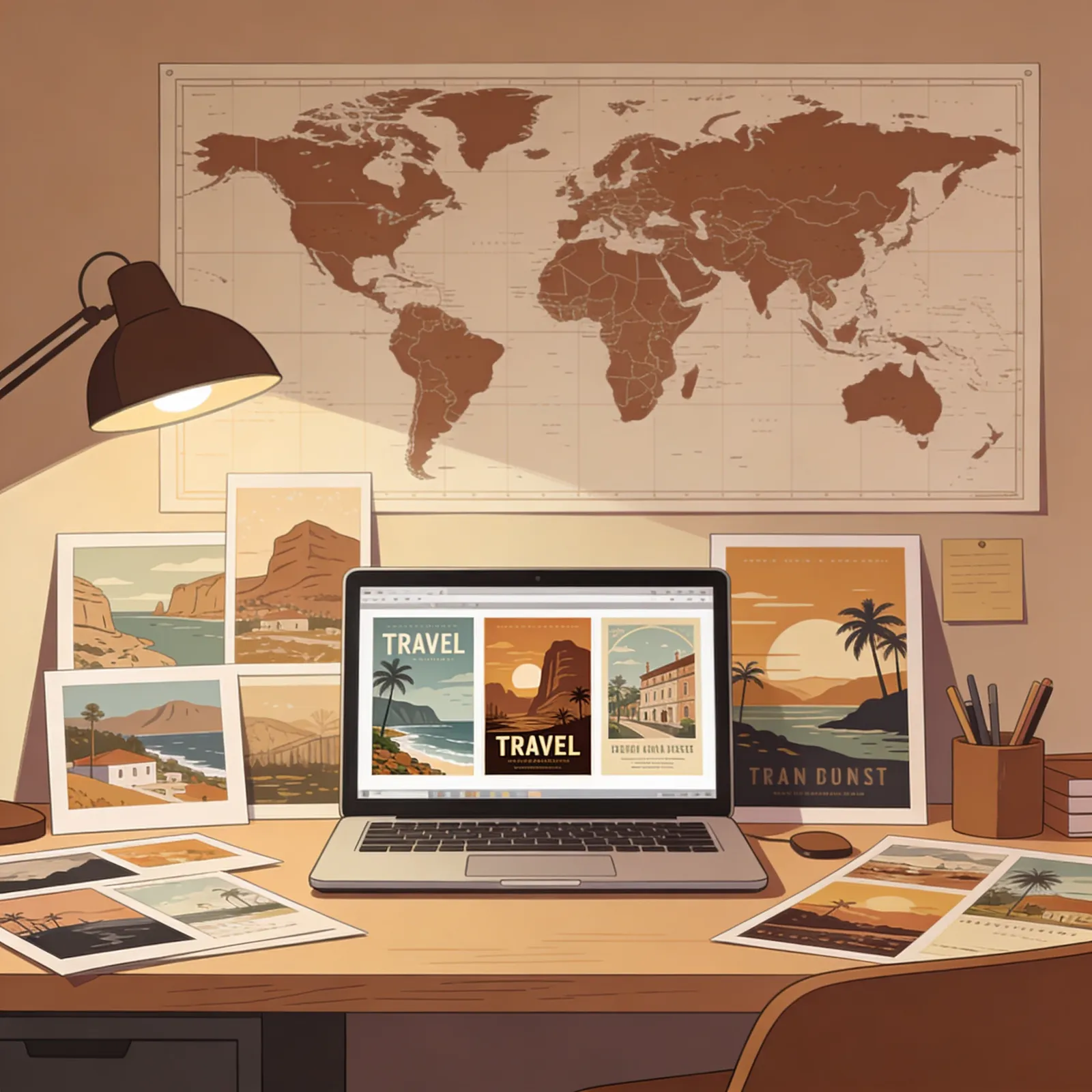
How Much Do Travel Print on Demand Sellers Make?
I've been in the online business trenches since the early 2000s, building affiliate sites, running SEO for major casinos, and experimenting with every monetization model you can imagine. So when I tell you that travel print on demand is one of the most accessible yet misunderstood income streams in 2026, I'm speaking from hard-won experience watching markets evolve.
Here's the direct answer most guides dance around: travel print on demand sellers typically fall into three clear tiers. Side hustlers putting in 5-10 hours weekly usually generate $500 to $2,000 per month in revenue, with actual profit landing between $150 and $800 after costs. Growing store operators who treat this as a serious part-time business see $2,000 to $10,000 monthly revenue, netting $800 to $4,500. Established sellers running this as their primary income source consistently hit $10,000 to $50,000+ in monthly revenue, with profit margins of 25-40% translating to $3,000 to $20,000 in their pockets.
But here's what separates the winners from the complainers on Reddit threads: they understand the difference between revenue and profit. I've seen too many sellers celebrate $10K months while bleeding cash on ads and underpriced products. In the travel niche specifically, the emotional connection buyers have with destinations creates pricing power that generic POD niches simply can't match. Someone buying a "Wanderlust Collection" hoodie featuring Patagonia isn't just buying fabric, they're buying a piece of their identity.
My experience in affiliate marketing taught me that travel converts on emotion, not logic. That same psychology applies to physical products. The key metrics I track for my consulting clients: average order value in travel POD typically runs $28-45, compared to $22-30 for general POD. Repeat purchase rates hover around 12-18% when you nail the branding, versus 5-8% for generic stores. These differences compound dramatically over 12-24 months.
Unit Economics and Profit Margins
Let me break down the exact math I use when evaluating whether a travel POD product is worth launching. This isn't theoretical, it's the same framework I applied when analyzing casino affiliate payouts and crypto mining profitability. Numbers don't lie.
Take a typical travel-themed premium t-shirt selling for $29.99. Your production cost through a provider like Printful or Printify runs $12.95 for a quality blank with DTG printing. Platform fees, whether Etsy's 6.5% transaction fee or Shopify's monthly subscription amortized across orders, add roughly $2.50 per unit. Shipping costs passed to customers typically cover themselves, but any free shipping promotions eat $4-6 from your margin. If you're running ads, a conservative cost per acquisition in the travel niche is $8-12 per customer. Suddenly, that $29.99 sale leaves you with $2-6 profit after all costs.
Now flip the script with smarter product selection. Travel posters printed on premium matte paper cost $7.50 to produce, sell for $24.99, and ship for $3-4. Platform fees drop to $1.60. Without ads, relying on Etsy SEO or Pinterest traffic, your profit per unit jumps to $12-15. That's a 48-60% margin versus 7-20% on apparel. This is why I always tell new sellers: start with wall art and accessories before touching apparel.
Here's the margin hierarchy I've observed across hundreds of travel POD stores:
- Travel posters and art prints: 50-65% margins (the gold standard)
- Mugs and drinkware: 40-55% margins (great impulse buys)
- Tote bags and accessories: 35-50% margins (practical, giftable)
- Phone cases: 30-45% margins (high volume, low ticket)
- Apparel (tees, hoodies): 15-35% margins (competitive, ad-dependent)
- Canvas wraps: 25-40% margins (higher ticket, lower volume)
The biggest margin killer I see? Sellers pricing based on competitors without calculating their own numbers. I learned this lesson painfully in my early affiliate days, undercutting everyone just trains customers to expect discounts. In travel POD, premium pricing with strong branding consistently outperforms race-to-the-bottom strategies.
Best-Selling Travel Products
After analyzing thousands of listings and managing SEO for travel-adjacent businesses, certain product categories consistently outperform. Here's what's actually selling in 2026, not what YouTube gurus claim works:
1. Destination Map Posters (Price: $22-35, Competition: Medium-High)Minimalist city maps, vintage-style national park prints, and topographic trail maps dominate this category. The key differentiator isn't design complexity, it's research. Sellers who incorporate accurate trail data, neighborhood labels, or historical landmarks see 3-5x more engagement than generic map designs. Seasonal peak: November-December (gift buying) and March-May (travel planning season).
2. National Park Collection Apparel (Price: $28-42, Competition: High)The "park badge" aesthetic on hoodies and tees remains strong, but the winners are moving toward subtle, nature-inspired designs rather than obvious park logos. Think topographic patterns, wildlife silhouettes, and vintage camp aesthetics. Margins are tighter here, but volume potential is massive if you crack Etsy or Amazon Merch visibility.
3. Travel-Themed Mugs (Price: $16-24, Competition: Medium)City skyline mugs, "I'd Rather Be in [Destination]" designs, and adventure quote mugs. Low production cost ($5-7) means healthy margins even at competitive pricing. Gift potential drives Q4 sales, but steady baseline demand exists year-round from travel enthusiasts.
4. Wanderlust Tote Bags (Price: $18-28, Competition: Low-Medium)Canvas totes with travel quotes, compass designs, or destination coordinates. Production costs run $8-11, leaving solid margins. The sustainable travel crowd loves these as plastic bag alternatives, creating a values-driven purchase motivation that reduces price sensitivity.
5. Adventure Journal Notebooks (Price: $14-22, Competition: Low)Spiral or hardcover journals with travel-themed covers, bucket list interiors, or topographic patterns. This is an underserved sub-niche I'm personally bullish on. Production costs of $5-8 mean excellent margins, and the journaling trend shows no signs of slowing. Bundling with matching pens or stickers increases AOV significantly.
6. Customizable City Coordinates Prints (Price: $18-30, Competition: Medium)Personalized prints featuring coordinates of meaningful locations, where someone got engaged, their hometown, a dream destination. Personalization adds perceived value and reduces price comparison. Production complexity is minimal with variable data printing integrations.
7. Passport Covers and Travel Wallets (Price: $16-26, Competition: Medium)Leather-look or fabric passport holders with wanderlust quotes, world map patterns, or minimalist designs. These hit the sweet spot of practical use and emotional appeal. Gift buyers love them, and repeat purchase potential exists as travelers upgrade or gift to friends.
8. Adventure Sticker Packs (Price: $8-15, Competition: Low-Medium)Sets of 5-10 vinyl stickers featuring mountain ranges, compass designs, trail markers, and outdoor quotes. Low production cost ($2-4 per pack), lightweight shipping, and impulse-buy pricing make these excellent entry products. They also serve as low-risk upsells and cart-stuffers.
Real Seller Case Studies
Over the years consulting for e-commerce brands, I've tracked dozens of travel POD sellers. Here are five profiles that represent realistic outcomes, no survivorship bias, no course-selling gurus inflating their numbers:
Case Study 1: The Weekend WarriorSarah runs a 45-design Etsy shop focused on national park posters. She invests 8-10 hours weekly alongside her marketing job. Monthly revenue: $1,800-2,400. After Printify costs ($620 avg), Etsy fees ($210), and occasional Etsy ads ($150), she nets $820-1,220. Her strategy: exceptional mockup photos showing prints in real cabin and living room settings, detailed SEO-optimized titles using Marmalead for keyword research, and a 48-hour response time on messages. She's launched 3 new designs monthly for 14 months, now seeing organic compounding as reviews accumulate.
Case Study 2: The Full-Time BuilderMarcus left his graphic design job 22 months ago to focus on his travel POD brand across Etsy and Shopify. He now manages 180+ SKUs across posters, apparel, and accessories. Monthly revenue: $12,000-15,000. His cost structure: production ($4,800), platform fees ($1,200), Shopify subscription ($39), email marketing tool ($49), Pinterest ads ($800), and freelance designer help ($600). Net profit: $4,500-6,200 monthly. His breakthrough came from building a Pinterest presence with 40,000+ monthly viewers and an email list of 8,200 travel enthusiasts. He launches seasonal collections tied to travel booking trends, ski destinations in September, beach locations in January.
Case Study 3: The Amazon Merch OperatorDavid focuses exclusively on Amazon Merch on Demand, targeting travel-themed t-shirts and hoodies. He's tiered up to 2,000 designs over 3 years. Monthly royalties: $3,500-5,500 depending on seasonality. Amazon handles everything, he just uploads designs and optimizes listings. His effective hourly rate is exceptional given the 5-7 hours weekly he invests, but growth is capped by Amazon's tier system and the platform's lack of customer data access. He can't build an email list or retarget customers, which limits long-term brand value.
Case Study 4: The Niche DominatorJennifer identified an underserved sub-niche: scuba diving destination art. She creates detailed underwater topography maps and marine life illustrations for 30+ dive locations. Monthly revenue: $8,000-9,500 across Etsy and her Shopify store. Her 55% margins come from premium pricing ($35-55 for framed prints) and a passionate customer base that shares her work in diving forums and Facebook groups. She's built genuine authority by being a certified diver herself, and her product descriptions include actual dive site information that demonstrates expertise. Customer acquisition cost is near zero, her community does the marketing.
Case Study 5: The Cautionary TaleI'm including this because I've seen it too many times. Tom invested $4,000 in a "done-for-you" travel POD store, spent $2,500 on Facebook ads his first month, and generated $3,100 in revenue with $2,900 in product costs. After ad spend, he lost $2,300. He had 200 generic designs with no niche focus, poor mockups, and no understanding of his target customer. His store closed within 4 months. The lesson: no amount of ad spend fixes poor product-market fit. Start small, validate with organic traffic, then scale what works.
Getting Started: First Product to First Sale
I've launched enough online ventures to know that paralysis by analysis kills more businesses than bad ideas ever will. Here's the exact sequence I'd follow if I were starting a travel POD store today in 2026:
Step 1: Niche Selection (Week 1)Don't target "travel" broadly, that's like opening a "food" restaurant. Pick a specific angle. National park enthusiasts, digital nomads, solo female travelers, van lifers, destination wedding attendees. I use a simple scoring system: search volume (Google Trends + Etsy search suggestions), competition density (number of existing listings with 100+ reviews), and my personal interest/knowledge in the niche. The intersection of decent demand and low competition is where you start. For my first adult industry site in 2003, I picked a micro-niche nobody was targeting, same principle applies here.
Step 2: Design Creation (Week 1-2)You don't need to be a designer. Canva Pro ($13/month) handles 80% of travel POD design needs. For map-based designs, Snazzy Maps and open-source GIS data create unique looks. I recommend creating 10-15 designs before launching, this gives you enough inventory to look legitimate without overinvesting. Test concepts before perfecting: list rough mockups on Etsy, see which get clicks and favorites, then refine the winners. My crypto investing taught me to validate before going all-in; same applies here.
Step 3: Platform Selection (Week 2)For most beginners, Etsy is the correct starting point. Why? Built-in buyer traffic of 90+ million active shoppers, low listing fees ($0.20 per item), and customers actively searching for unique travel gifts. Shopify makes sense once you're generating consistent sales and want brand control, but starting there means you're responsible for driving all your own traffic. I've seen too many new sellers pay $39/month for an empty Shopify store for six months. Start where the buyers already are.
Step 4: POD Provider Integration (Week 2)Connect Printful or Printify to your Etsy store. Both offer similar quality and pricing in 2026. Printful has slightly better print quality and branding options; Printify offers more competitive pricing through their provider network. I typically recommend Printify for beginners due to lower costs, but order samples from both to compare. The $30-50 you spend on samples will save you from selling products that disappoint customers.
Step 5: Listing Optimization (Week 2-3)This is where my 20+ years of SEO experience provides an edge. Etsy SEO isn't Google SEO, but the principles overlap. Your title should front-load the primary keyword while reading naturally: "Yosemite National Park Poster, Half Dome Wall Art, California Travel Print, Hiking Gift, Outdoor Adventure Decor." Use all 13 tags with long-tail variations. Fill out every attribute field. Write descriptions that combine emotional storytelling with practical details. My casino affiliate background taught me that search engines reward thoroughness, leave no field empty.
Step 6: Photography and Mockups (Week 3)This step separates professionals from hobbyists. Invest in high-quality mockup templates ($15-40 for bundles on Creative Market) showing your prints in aspirational settings: a cozy cabin living room, a modern apartment gallery wall, a traveler's desk with a passport and camera. Etsy's algorithm favors listings with multiple high-resolution images. I use Placeit for apparel mockups and Etsy-purchased scene creators for wall art. Your photos should make customers imagine the product in their own space.
Step 7: Pricing Strategy (Week 3)Calculate your all-in costs first, then apply your target margin. For a poster costing $7.50 to produce with $3.50 shipping and $1.80 in Etsy fees, your breakeven is $12.80. I recommend pricing at $24.99-29.99 initially, this signals quality while leaving room for 10-15% off promotions without destroying margins. Offer free shipping on orders over $35 to increase average order value. My years of split-testing in affiliate marketing proved that psychological pricing ($24.99 vs $25.00) still works, though less dramatically than in the 2010s.
Step 8: Launch and First Sale (Week 4+)Your first sale rarely comes from strangers, it comes from activation. Share your shop link in relevant Facebook groups (not spam, genuinely contribute first), on your personal social media, and with friends who love travel. Ask for honest reviews. Etsy's algorithm needs social proof to start ranking you organically. Most sellers get their first sale within 1-3 weeks of consistent effort. My first affiliate site took 6 months to make its first dollar, POD moves much faster when you execute properly.
Marketing and Customer Acquisition
Having managed SEO for businesses spending $50K+ monthly on acquisition, I can tell you that travel POD marketing requires a different playbook than most e-commerce. The emotional purchase motivation changes everything.
Etsy SEO (Your Primary Channel)Mastering Etsy search is non-negotiable. The algorithm considers: listing quality score (clicks, favorites, purchases), recency (new listings get a temporary boost), shop completeness (filled policies, about section, shop icon), and customer experience metrics (review scores, message response time, shipping accuracy). I research keywords using Etsy's search bar autocomplete, then validate with eRank or Marmalead. Target long-tail keywords where you can realistically rank in the top 20 within 30 days. "Minimalist travel poster" with 50,000 results is harder than "Zion National Park minimalist art print" with 2,000 results.
Pinterest MarketingPinterest is a visual search engine, not social media, this distinction matters. Travel content performs exceptionally well here, with pins having a 4-month average lifespan versus 24 hours on Instagram. Create 5-10 pins per product listing, varying the imagery and descriptions. Use Rich Pins to sync pricing and availability automatically. The travel niche sees 40% higher engagement rates on Pinterest compared to general lifestyle content. I've seen sellers drive 5,000-15,000 monthly website visits purely from Pinterest after 6-8 months of consistent pinning using Tailwind for scheduling.
Paid Advertising RealitiesFacebook and Instagram ads for travel POD products typically see 1.5-2.5x ROAS initially, meaning you're likely losing money on the first purchase. The profit comes from email capture and repeat purchases. TikTok ads perform better for travel products with strong visual hooks (packing videos, room transformations, gift unboxings), often achieving 2.5-4x ROAS. But platform volatility is high, what works this month may not work next quarter. I recommend organic validation before scaling with paid ads, a lesson I learned from watching too many casino affiliates burn through budgets chasing unprofitable keywords.
Email Marketing for Travel PODThis is chronically underutilized. Travel purchases are emotionally driven and often gift-oriented, making email sequences highly effective. Build your list with a 10% discount popup, then send: welcome series (brand story, bestsellers, social proof), destination-specific collections ("Planning a trip to Iceland? Here's art inspired by the land of fire and ice"), seasonal gift guides (Mother's Day for the travel-loving mom), and restock notifications. My own affiliate experience proved that email converts at 3-5x the rate of cold traffic. A 1,000-person travel POD email list generating $500-1,000 per send is entirely realistic.
Influencer and UGC StrategyTravel influencers with 5,000-50,000 followers often accept product-for-post arrangements. Send them a free print featuring their favorite destination, and they'll typically share it with their engaged audience. This generates authentic content you can repurpose as social proof. User-generated content, customers sharing photos of your prints in their homes, provides free marketing material. Create a branded hashtag and feature customer photos prominently. This social proof loop reduces ad costs and improves conversion rates across all channels.
Scaling and Operations
Scaling a travel POD business isn't just about adding more designs, it's about building systems that maintain quality as volume increases. I've scaled businesses from solo operations to teams, and the transition points are predictable.
When to Add ProductsDon't fall into the quantity trap. I've seen stores with 500 mediocre designs get crushed by competitors with 50 excellent ones. Add products when you have data showing what sells. Analyze your top 20% of listings, they likely generate 80% of revenue. Create variations on winners: different color schemes, complementary destinations, product type expansions (if a Yosemite poster sells, add a Yosemite mug, tote, and notebook). My rule: launch 3-5 new products weekly once you have 90 days of sales data, always informed by what's already working.
Hiring HelpYour first hire should be a designer, not a virtual assistant. At $15-25/hour, a skilled designer on Upwork can create 10-15 quality travel designs weekly, freeing you for strategy and marketing. Once you're spending 10+ hours weekly on customer service, hire part-time help for $12-18/hour. I didn't hire my first assistant until my affiliate business was doing $8K/month, I should have done it at $5K. The mental bandwidth recovery is worth the cost.
Multi-Platform ExpansionOnce Etsy is generating consistent sales, expand to Amazon Merch (if you can get accepted) and your own Shopify store. But here's the sequencing that works: master one platform for 6-12 months before adding another. Each platform has unique algorithms, customer expectations, and operational requirements. Spreading too thin too early is a top-5 reason travel POD stores fail. I expanded my casino affiliate sites too aggressively in 2008 and watched rankings collapse across multiple domains, focus wins.
Seasonal PlanningTravel POD has pronounced seasonality. Q4 (October-December) generates 35-50% of annual revenue for most sellers due to holiday gifting. January-March sees a travel planning bump as people book spring and summer trips. Summer months often slow down as people are traveling rather than shopping for travel products. Plan your product launches, ad spend, and inventory (for any stocked items) around these cycles. Build cash reserves during Q4 to sustain slower months, a lesson my crypto volatility experience reinforced about managing through cycles.
Platform Fees and Hidden Costs
Let me give you the unvarnished cost breakdown that most "start your POD empire" guides conveniently omit. I've audited enough e-commerce P&Ls to know exactly where money leaks occur.
Etsy Fee Structure (2026):
- Listing fee: $0.20 per item (renews every 4 months or when item sells)
- Transaction fee: 6.5% of sale price (including shipping charged to customer)
- Payment processing: 3% + $0.25 per transaction
- Offsite ads fee: 12-15% of sale if customer clicks an Etsy-placed ad (mandatory once you hit $10K in 12-month sales)
- Etsy Plus subscription: $10/month (optional, for advanced shop customization)
On a $29.99 poster with $4.99 shipping, that's: $0.20 listing + $2.27 transaction + $1.30 processing = $3.77 in fees (10.8% of total). Add the offsite ads fee if applicable, and you're looking at 15-27% total platform costs.
Shopify Fee Structure:
- Basic plan: $39/month (annual billing)
- Transaction fees: 2.9% + $0.30 if using Shopify Payments (2% additional if using third-party processor)
- App costs: $20-100/month for essential apps (email marketing, reviews, SEO optimization)
- Domain: $14/year
Shopify's lower per-transaction fees are offset by the monthly subscription and the need to drive your own traffic. The breakeven point where Shopify becomes cheaper than Etsy is typically around $3,000-5,000 in monthly sales, depending on your traffic sources.
Hidden Costs Nobody Mentions:
- Sample orders: $50-150 upfront to verify quality across products
- Design tools: $13-55/month for Canva Pro, Adobe Illustrator, or Placeit
- Research tools: $10-30/month for eRank, Marmalead, or EverBee
- Return costs: POD providers typically don't cover return shipping for customer remorse returns, budget 2-5% of revenue for replacements and refunds
- Tax compliance: $0-200/year depending on whether you handle sales tax yourself or use a service like TaxJar
- Chargebacks: $15-25 per incident, plus lost product cost
- Time cost: Your hourly rate matters. If you're spending 30 hours weekly to net $1,500, you're making $12.50/hour, less than minimum wage in many states
Mistakes That Kill Travel Stores
I've watched hundreds of POD stores launch and fail. The patterns are so consistent that I can predict failure within 60 days of launch. Here are the fatal errors to avoid:
1. Generic Designs Without Niche Focus"Live, Laugh, Travel" on a t-shirt isn't a business strategy. The travel POD winners dominate specific micro-niches: van life retirees, Appalachian Trail thru-hikers, Patagonia trekking enthusiasts. Generic designs face infinite competition and zero pricing power. My first website in the adult industry succeeded because I targeted a specific fetish nobody else was serving, broad markets crush beginners.
2. Pricing Below Sustainable MarginsI see sellers pricing travel posters at $14.99 because they're afraid of charging more. At that price with POD costs, you're making $2-3 per sale before any advertising. One return wipes out profit from 5-6 sales. Price for the value you provide, not based on competitor fear. Premium pricing also attracts better customers, fewer complaints, fewer returns, higher review scores.
3. Terrible Mockup PhotosYour product photos are your entire storefront. Using the default mockups from your POD provider screams amateur. Invest in scene-setting mockups that show your travel prints in aspirational environments. One seller I consulted tripled her conversion rate simply by switching from plain white background photos to lifestyle mockups showing prints in beautifully decorated rooms.
4. Ignoring Customer Service Response TimeEtsy penalizes shops with slow response times. I respond to all messages within 4 hours during business hours, using the mobile app to maintain responsiveness. Customer questions about sizing, shipping times, or customization options are buying signals, every delayed response is a potential lost sale.
5. Overinvesting Before Product-Market FitI've seen sellers spend $2,000 on inventory, $500 on a logo, and $1,000 on ads before selling a single unit. Start with 10-15 designs on Etsy. Make 10 sales. Get 5 reviews. Then reinvest profits into expansion. My crypto gains came from early, small bets that I scaled after validation, business building works the same way.
6. Neglecting Listing SEOBeautiful designs with terrible titles and no tags will never be found. I audit failed stores and consistently find listings with 3-word titles, 5 of 13 tags used, and no attributes filled. Etsy gives you 13 tag fields for a reason, use every single one with relevant search terms. My SEO career has been built on the boring fundamentals that competitors skip.
7. Copying Bestsellers DirectlyFinding a best-selling design and creating a slightly modified version isn't a strategy, it's a copyright lawsuit waiting to happen. More importantly, you'll always be the cheaper alternative to the established seller. Original designs that serve specific communities create defensible moats that copycats can't breach.
Is Travel Print on Demand Worth It?
After 20+ years building online businesses across industries, here's my honest assessment of travel POD in 2026:
Capital Requirements: You can start with $100-300. This covers Etsy listing fees for 20-30 products, a month of Canva Pro, sample orders, and initial mockup purchases. Compare this to the $3,000-10,000 needed to launch a private label product or the $50,000+ for a franchise. POD is genuinely accessible.
Time to First Sale: 1-4 weeks with active promotion. Time to consistent $1,000/month: 3-8 months with dedicated effort. Time to full-time income replacement ($4,000-6,000/month profit): 12-24 months for committed operators. These timelines assume you're treating this as a business, not a lottery ticket.
Competition Level: High but fragmented. The travel POD market has thousands of sellers, but most produce mediocre work. Standing out requires genuine design taste, niche knowledge, or marketing skill, ideally all three. The barrier to entry is low, but the barrier to meaningful income is moderate.
Who This Suits Best: Travel POD works well for designers looking to monetize their skills, travel enthusiasts who understand specific communities, marketers who can drive traffic, and side-hustlers willing to learn multiple disciplines. It works poorly for people seeking passive income with minimal effort, that ship sailed in 2018.
Comparison to Other Travel Monetization: Travel blogging typically takes 18-36 months to generate meaningful income and requires consistent content creation. Travel affiliate sites face brutal Google algorithm volatility (I've lived through every update since Florida in 2003). Travel photography requires expensive equipment and travel costs. POD offers faster monetization with lower upfront investment, but ceiling is lower than building a media brand. My recommendation: start with POD to generate cash flow, then reinvest profits into higher-ceiling assets like niche travel sites or digital products.
The travel print on demand opportunity in 2026 is real but requires realistic expectations. I've seen it change lives for sellers who treat it seriously, and I've seen it waste months for those chasing easy money. The math works if you work the math. Start small, validate ruthlessly, and scale what proves itself. That approach built my career across adult, gambling, crypto, and SaaS, and it works just as well for travel POD.